From Brussels to Glasgow, INESC TEC boosted advances in interoperability and portability of models, services, processes and data associated with ocean digital twins. At both the EDITO Digital Ocean Forum and the AGU Ocean Sciences Meeting 2026, the outcomes of the Iliad project took centre stage within the ambition to create a digital twin of European seas.
The recent OceanEye initiative, announced by the European Union, underscores a shared vision for the ocean: fostering close cooperation for the observation and protection of European seas. This endeavour builds on several existing EU efforts, including the EDITO (European Digital Twin Ocean) platform – which, as the name suggests, aims to bring together data, models and services to create a digital twin of the ocean at a European level.
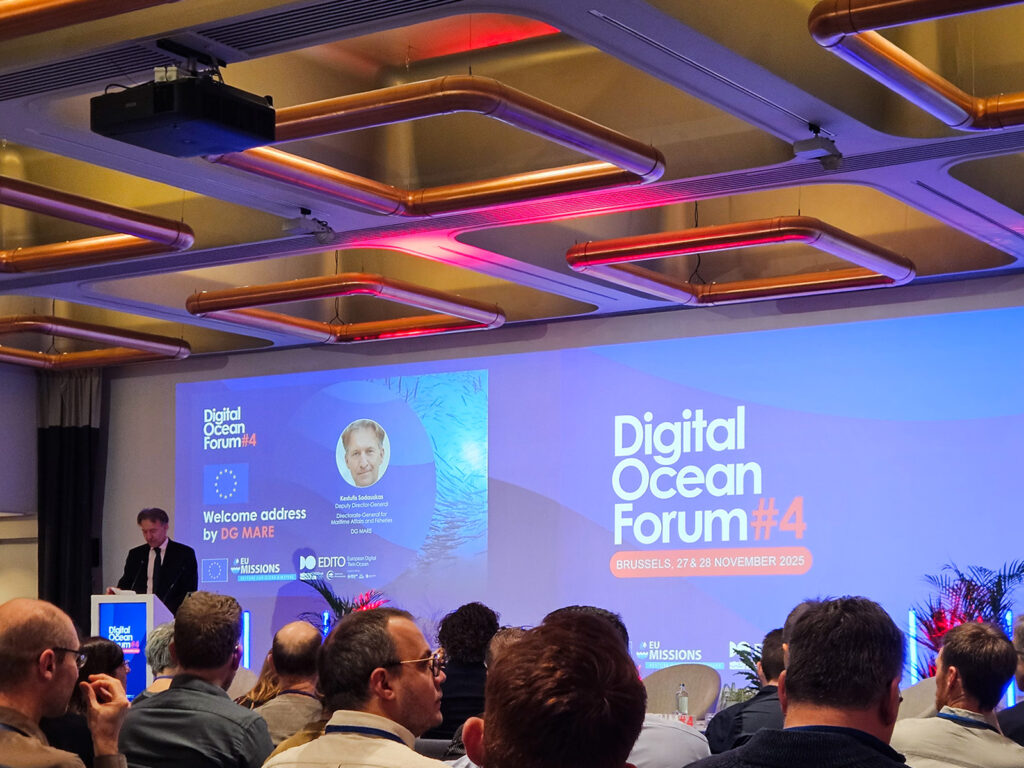
In this sense, the results and contributions of the Iliad project – with INESC TEC playing a pivotal role – reinforce this collective effort, particularly regarding the need for interoperability among the various digital twins of the global maritime space. Recently, the Institute had the opportunity to present and discuss developments associated with this European project at two major international events in ocean sciences and marine digitalisation: the Digital Ocean Forum in Brussels, Belgium, and the AGU Ocean Sciences Meeting 2026 in Glasgow, United Kingdom.
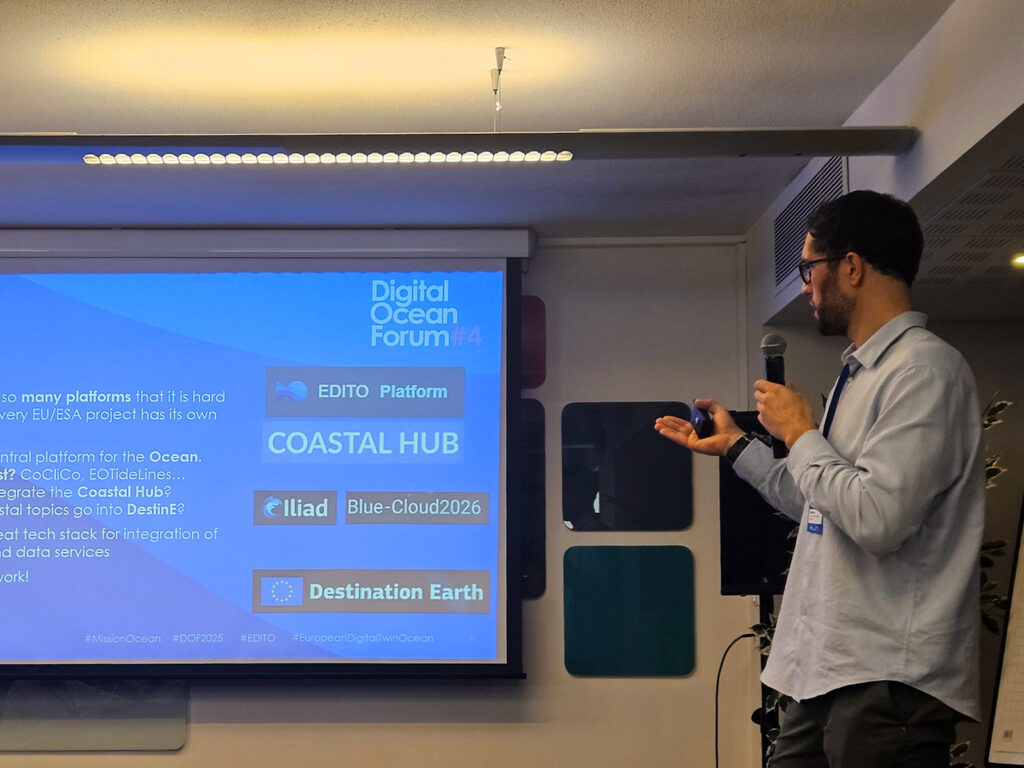
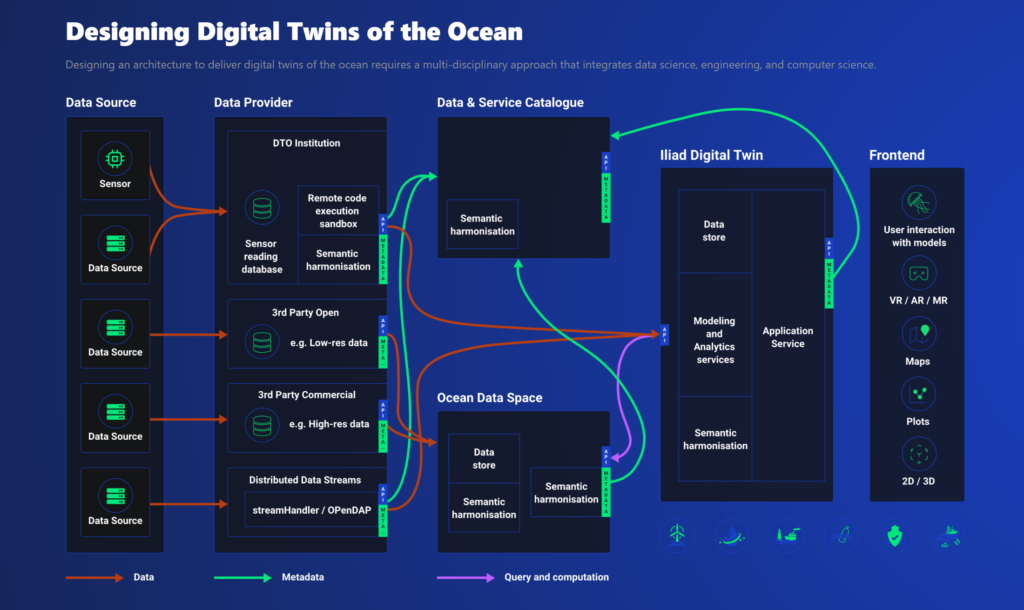
Marco Amaro Oliveira, INESC TEC researcher involved in the project, mentioned that Iliad aimed to promote “a federated and distributed architecture of digital twins, enabling cooperation between local digital twins”, based on a model of sovereign sharing of interoperable data, models and applications.
This type of architecture allows digital twins not only to address questions about the present state (What now?), the past (What in the past?), and forecasts and simulations (What future? and What if?) of the ocean, but also to interact with other digital twins (What else?), accessing external data and models that may influence or be influenced by the scenarios under analysis.
Marco Amaro Oliveira further explained that, complementing the EDITO platform, Iliad assumes that “local digital twins can be managed by public or private organisations that seek to retain sovereignty over their data and services”.
Within the Iliad project, INESC TEC was responsible (among other tasks) for defining the architecture supporting interoperability of processes and services between applications and systems associated with ocean digitalisation. As the researcher highlighted, Iliad’s outcomes may play a significant role in “supporting the deployment of processes [related to building digital twins] within EDITO itself”.
In fact, “simplifying workflows associated with the deployment of processes and applications was presented as one of the key priorities among the challenges for improving the EDITO application environment. The architecture resulting from the Iliad project enables the INESC TEC team to deploy new processes quickly”, thereby simplifying the onboarding process on this European platform.
The exploration of digital twin interoperability also emerged from the ecosystem fostered by EDITO, nurturing what Marco Amaro Oliveira described as a symbiotic relationship: “we sought to benefit from what was being made available within EDITO, while also influencing, as far as possible, the definition of its architecture with the results we had achieved in the Iliad project – for example, regarding the technical and semantic interoperability of processes and data”.
Some of the results achieved by the Iliad project reflect precisely this collaboration. According to the INESC TEC researcher, the initiative’s contributions translate into the “multiple processes and digital twin applications that the project made available within the European EDITO infrastructure, which can currently be executed ‘as a service’”.
From availability to execution: INESC TEC’s vision
Within the framework of the federated digital twin architecture promoted by Iliad, one of the priorities was to facilitate the integration, availability and execution of models across different digital infrastructures.
Hence, services such as APR – Application Package Registry – and APK2EDITO, developed by INESC TEC, emerged, designed to support and simplify these activities.
The APKG2EDITO feature allows, for example, “a digital twin operating within INESC TEC’s infrastructure, completely autonomous from EDITO, to install a given model on that platform and use it for execution. Subsequently, it is possible to import the execution results back into the digital twin”, illustrated Marco Amaro Oliveira.
To support and streamline this cooperative process, the project also included the development of the APR registry platform, defined as a catalogue for processes and models associated with digital twins. In this context, it is essential to ensure that these are not only accessible through actions driven by human users, but also interpretable and usable by software agents.
Complying with the FAIR principles (Findable, Accessible, Interoperable, and Reusable), the Iliad project sought to ensure that these resources were equipped with structured, machine-readable descriptions, making it possible not only to identify “what they are” (metadata and purpose) but also “how they can be used”, in terms of access conditions, integration and execution.
This capacity for machine interpretation and execution (machine-actionability) allows systems to discover, evaluate and reuse models autonomously, much as a human user would, but at the scale and speed required by distributed digital twin ecosystems.
Additionally, “APR enables the existence of a system akin to ‘Open Science’, in which a model can be published, associated with a unique persistent identifier and other relevant metadata, supporting the functionalities described above”, said Marco Amaro Oliveira.
The APR platform is based on open-source technology and open standards as a model search and access framework. As the researcher explained, “this approach was based on API records from the OGC – Open Geospatial Consortium – and on this consortium’s best practices for containerising and describing Earth observation applications – Earth Observation Application Packaging”.
“The results are being used to contribute to the OGC community, influencing the evolution of standards and best practices. These contributions are also being presented within the IEEE [Institute of Electrical and Electronics Engineers], through team members’ participation in IEEE-IC [Digital Twin of the Earth – Tools and Resources for Interoperable Development and Operations] and in the definition of a recommended practice for the development of digital twins of the Earth – through the IEEE P3501 initiative.”
Marketplace and academia: sharing knowledge about the virtual ocean
One of the project’s main outcomes is also the availability of the Iliad Marketplace: a platform that is already “available online and brings together contributions developed by project partners for this distributed and federated digital twin architecture”, highlighted Marco Amaro Oliveira.
“We had several contributions from different partners, not only in terms of developing new technologies, but also models, data, and new digital twins, all made available on the platform.” According to the INESC TEC researcher, the idea is to make it possible “to find and access what has been developed and how it has been applied”.
In addition to this digital infrastructure, the project also promoted the Iliad Academy, which included several training initiatives such as webinars and Summer Schools: “we held two Summer Schools, with the content from these training activities made available through this online platform”.
Following the project’s completion, some partners came together to collaborate on an “epilogue”. Using Iliad’s results, they created and demonstrated a digital twin for the United Kingdom’s Marine Protected Areas. “Now we have a service (already integrated into EDITO) for classification, analysis and simulation of What If? scenarios for the UK’s MPAs (Maritime Protected Areas), where the use of OpenDrift [software for modelling the trajectories of objects or substances drifting in the ocean] enables the visualisation of potential impact between different protected areas in this region,” concluded the INESC TEC researcher.