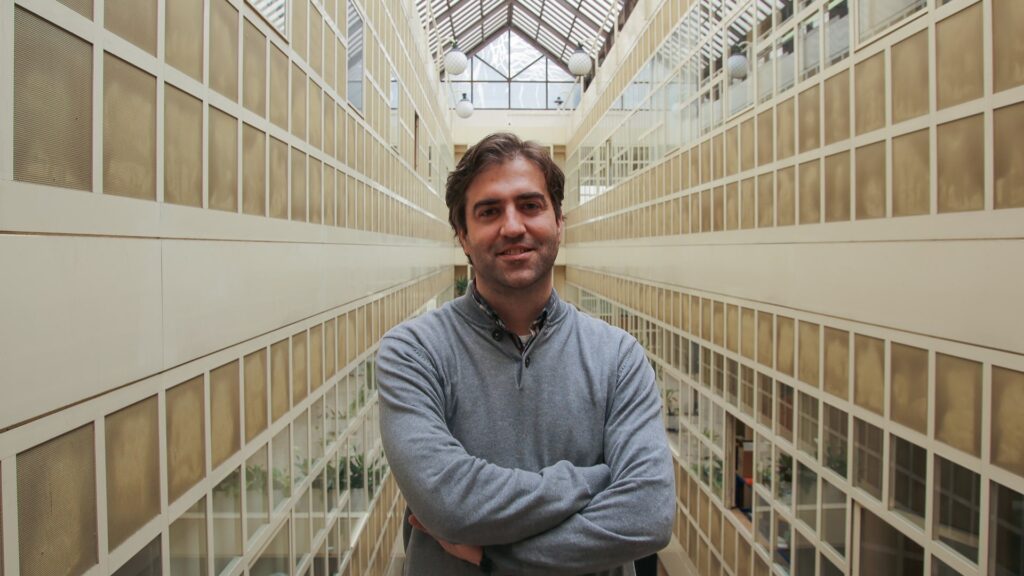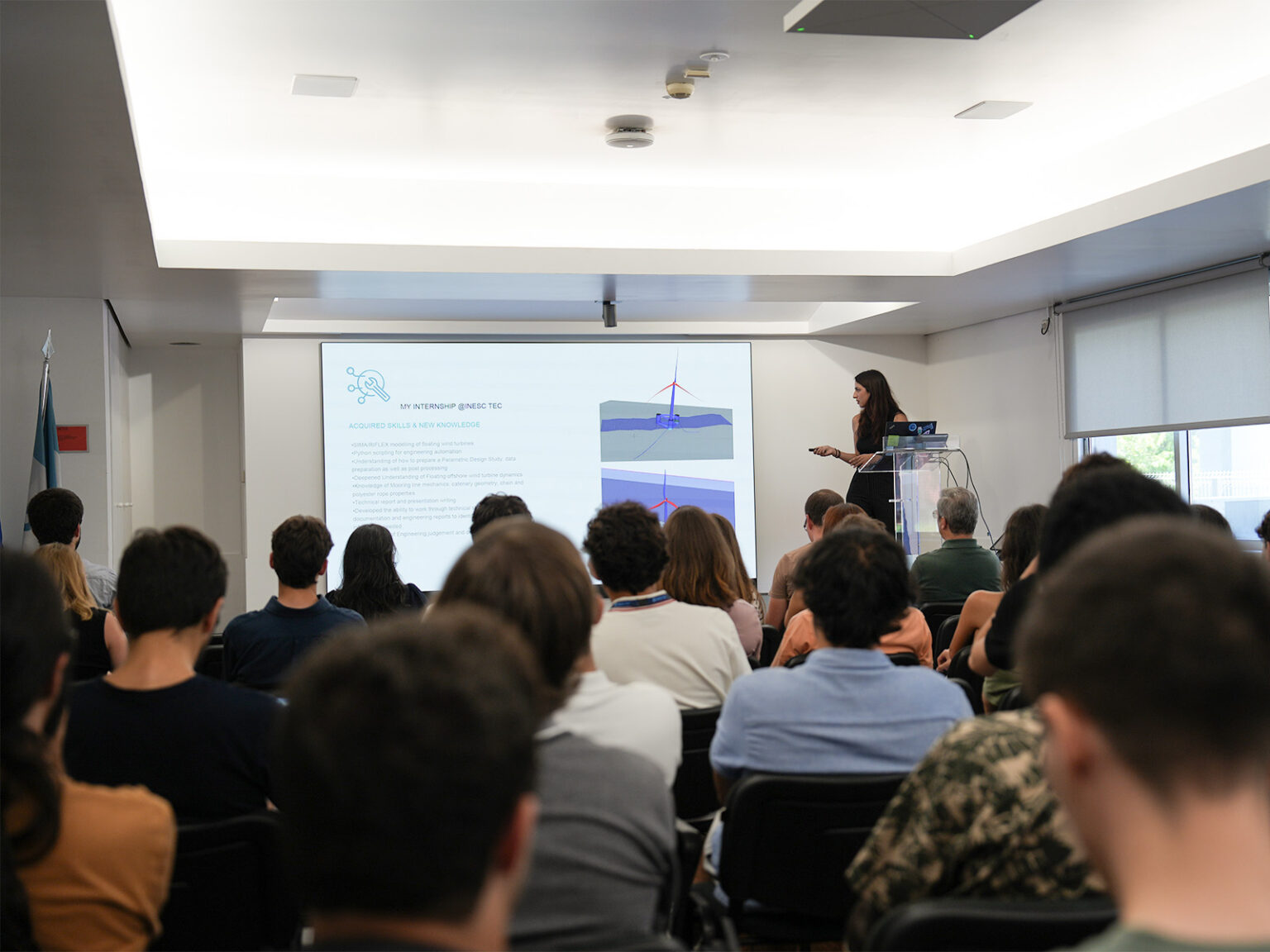
The usual INESC TEC Summer Internship programme welcomed three students to the Centre of Excellence in Ocean Research & Engineering. Throughout one month, participants had the opportunity to work in a research environment and strengthen their fundamental knowledge of ocean engineering.
Throughout July, Vasco, Constança and Dorina swapped an “exciting” holiday break for four weeks of continuous learning at INESCTEC.OCEAN. As part of INESC TEC’s Summer Internships programme, the three college students were able to “develop technical skills and methodologies essential to supporting offshore renewable energy and ocean monitoring projects, with a particular focus on the Aguçadoura test site,” explains Diogo Neves.
Alongside Dallán Friel, the two INESC TEC researchers took on the role of mentors for the internship carried out at the Centre of Excellence in Ocean Research & Engineering.
“The main objective was to provide a practical experience across several areas of industry and research,” underlines Dallán. “We wanted them to gain hands-on experience using engineering software and methodologies while developing knowledge and skills that will benefit them in their future academic and professional careers.”
Given the short duration of the internship, the researcher emphasises that “defining a realistic project scope and managing time effectively were essential.” “A significant effort also went into helping the students quickly become familiar with their respective topics and the engineering software used, while encouraging them to work independently, ask questions, and engage with other researchers whenever needed,” Dallán Friel points out.
Diogo Neves agrees that the “trade-off” between time and the “steep learning curve” was challenging, given that the topics covered, such as “metocean data, hydrodynamics of floating bodies and mooring dynamics, are highly specialised and are rarely explored in depth at undergraduate level.”
According to the researcher, while “providing the interns with a solid theoretical foundation,” it was also necessary to ensure that they achieved their objectives and “produced valuable results within the short summer period.”
Throughout the experience, Diogo Neves explains that the supervision aimed to provide the students with “professional integration in a multicultural environment,” characterised by “methodological rigour, autonomy and a connection to real-world projects.”
According to the researcher, it was essential to “encourage the students to understand the physics behind the problems and establish routines for validating data and/or models, rather than simply running software.”
At the same time, within a “collaborative” ecosystem, Diogo Neves says they sought to “ensure that the work carried out was not merely an academic exercise, but instead made a direct and tangible contribution to the group’s projects.”
The Aguçadoura test site as a digital workbench
The three students explored different but strategically complementary topics. Constança Carapuço wanted to learn more about metocean data analysis, that is, information on the meteorological and physical characteristics of the sea. This was why she applied for INESC TEC’s Summer Internship: “I wanted to gain practical experience, find out whether this was an area I would like to pursue in the future, and assess its potential as a topic for my master’s thesis.”
A Master’s student in Civil Engineering – specialising in Hydraulics, Water Resources and the Environment – at the Faculty of Engineering of the University of Porto (FEUP), Constança focused on the “Metocean Characterisation and Extreme Data Analysis for Offshore Mooring Systems”.
“The aim of this work was to collect and process long-term metocean datasets for the Aguçadoura test site,” in Póvoa de Varzim, explains the intern.
In this case, the student worked with two datasets containing records covering the past 50 years: ERA5 reanalysis data for wind and wave conditions, and SIMAR data for water levels and currents. Ultimately, the goal was to carry out a preliminary assessment of the Aguçadoura test site to “support the design and sizing of mooring systems.”
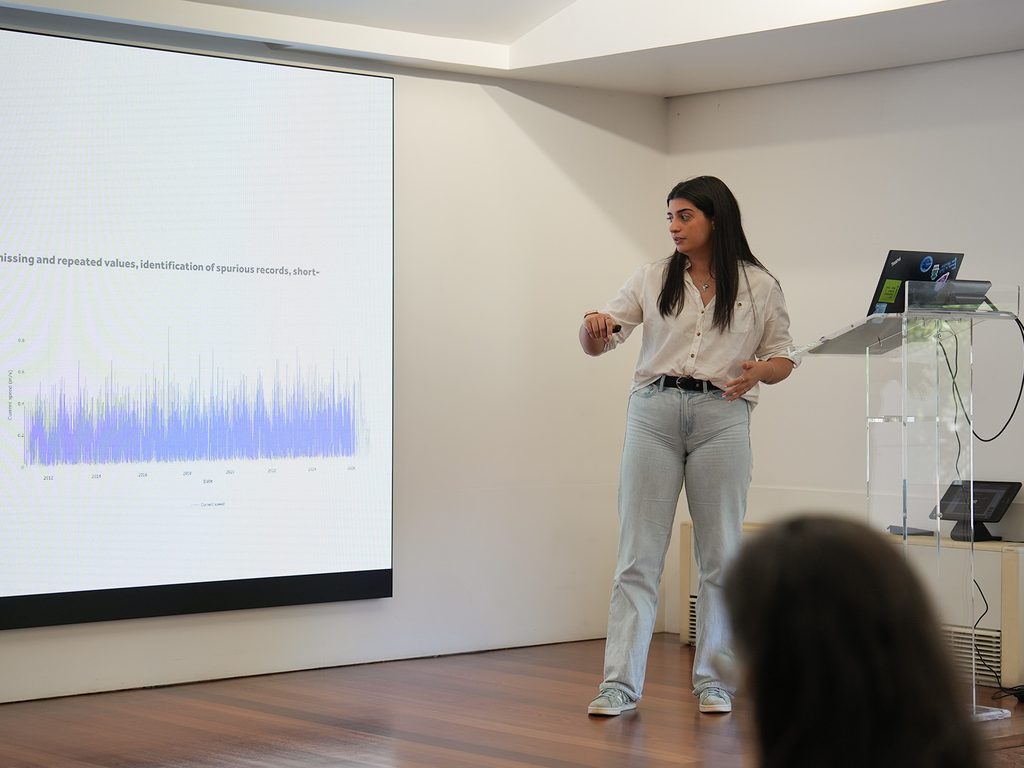
“I learned how to carry out data analysis, deepened my knowledge of Python and acquired the skills to perform a preliminary analysis of wave conditions, something I had not previously mastered,” explains Constança Carapuço.
“I loved being able to have a closer look on the technologies used for marine measurements and to learn more about other types of projects developed at the Centre [INESCTEC.OCEAN], particularly in the field of robotics.” The student describes the experience as “very enriching and inspiring,” saying that it certainly strengthened her “motivation to pursue a career connected to the maritime sector and metocean engineering.”
Vasco Carvalho “was already familiar with INESCTEC.OCEAN”, particularly with regard to the Centre of Excellence’s work in marine robotics. “Later, I realised that they were also involved in ocean engineering. As a Naval and Ocean Engineering student, the alignment could not have been better!” he exclaims, referring to what motivated him to join INESC TEC’s Summer Internship programme.
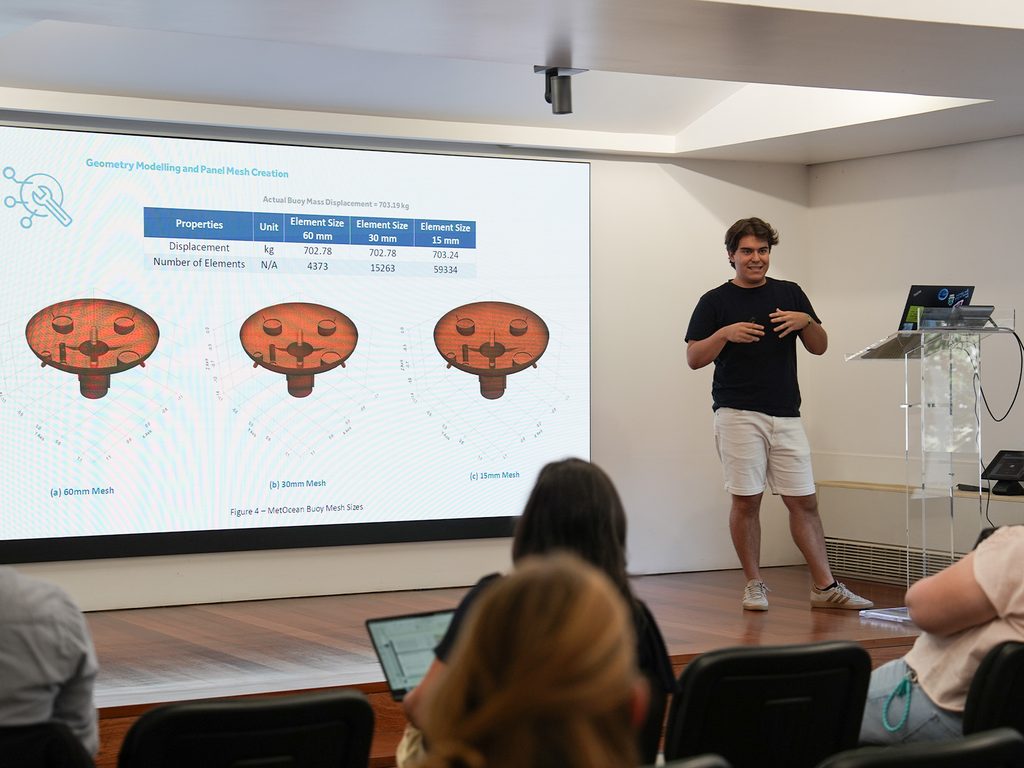
A second-year undergraduate student at the Instituto Superior Técnico (IST) of the University of Lisbon (UL), Vasco worked on the “Analysis of the Behaviour of Floating and Mooring Systems”. More specifically, the student from Portimão carried out a frequency-domain hydrodynamic study of a metocean buoy to be installed at the Aguçadoura test site.
“The main objectives were to perform a mesh convergence study to ensure the accuracy of the results and, subsequently, obtain the hydrodynamic coefficients as well as the RAOs (Response Amplitude Operators) of the buoy.”
RAOs – Response Amplitude Operators – are engineering parameters that describe the response of floating structures to waves of different frequencies. In this work, they were determined numerically through a frequency-domain hydrodynamic analysis. This approach makes it possible to predict the movement of the buoy in response to the waves under consideration.
According to Vasco Carvalho, his internship at INESCTEC.OCEAN provided him with an “important introduction to hydrodynamics and fluid–structure interactions.” “By learning to use DNV HydroD software, I understood how its low-fidelity approach works, based on Potential Flow Theory and the Boundary Element Method (BEM),” he adds.
In summary, while Potential Flow Theory is a branch of mathematics that studies harmonic functions, BEM is a numerical method for representing the interaction between waves and the surface of a floating structure. It is widely used to determine the hydrodynamic properties required to assess the behaviour of such structures at sea. Both approaches are frequently applied to the analysis of physical phenomena associated with fluid dynamics or wave propagation, for example.
For Vasco Carvalho, the internship further encouraged him “to pursue a career in the offshore industry”: “I acquired new concepts that will certainly be important for my career.”
From Athens to Porto, the “strong reputation of INESC TEC” attracted Dorina Ioannidou. A fourth-year undergraduate student in Civil Engineering – specialising in Hydraulics – at the National Technical University of Athens (NTUA), Greece, she already had experience in areas such as Technical Drawing, Building Energy Performance Studies and Basic Surveying, but had never interned or worked outside her home country.
“It was something I had considered doing in the future. I wanted to experience it first-hand, even if only for a short period, before making any definitive decisions. I also applied because this opportunity aligned with what I was looking for. Basically, it ticked all the boxes for me,” she explains.
Like Vasco, Dorina’s work focused on the “Analysis of the Behaviour of Floating and Mooring Systems”. More specifically, she studied the development of an automated Python tool for the analysis and design of mooring lines for 12 MW floating offshore wind turbines.
Also applied to the Aguçadoura test site, the objective was to “run simulations under realistic wind, wave and current conditions”, in order to “assess different mooring configurations and develop a preliminary mooring solution that met the ULS (Ultimate Limit State) acceptance criteria,” that is, the point beyond which a structure’s safety requirements are exceeded.
The student used RIFLEX modelling, a programme for the static and dynamic analysis of marine structural systems integrated into SIMA (Simulation Workbench and Model Analysis), a platform dedicated to run different simulation models.
“This experience allowed me to develop a greater understanding of the dynamics associated with floating offshore wind turbines and the mechanics of mooring systems,” says Dorina. For the intern, it was not only a “significant enhancement” of her technical skills in computational modelling and programming automation with Python, but also an opportunity for “personal and professional growth.”
“It taught me to work more independently, approaching unfamiliar problems with confidence,” she points out. The student also highlights the strengthening of her “engineering decision-making and assessment skills,” as well as her ability to collaborate and communicate more clearly when contributing to technical projects.
“Inspiring the next generation of ocean researchers and engineers”
At the end of the internship, the students thanked their mentors, Dallán Friel and Diogo Neves, for a “valuable experience” at INESCTEC.OCEAN. Dorina Ioannidou describes it as such, admitting that she was “genuinely inspired by the collaborative environment,” which brought together engineers and researchers who were “highly committed, intelligent and dedicated.”
“At the same time, they were also very friendly, approachable and welcoming, especially towards someone coming from a different country and background.”
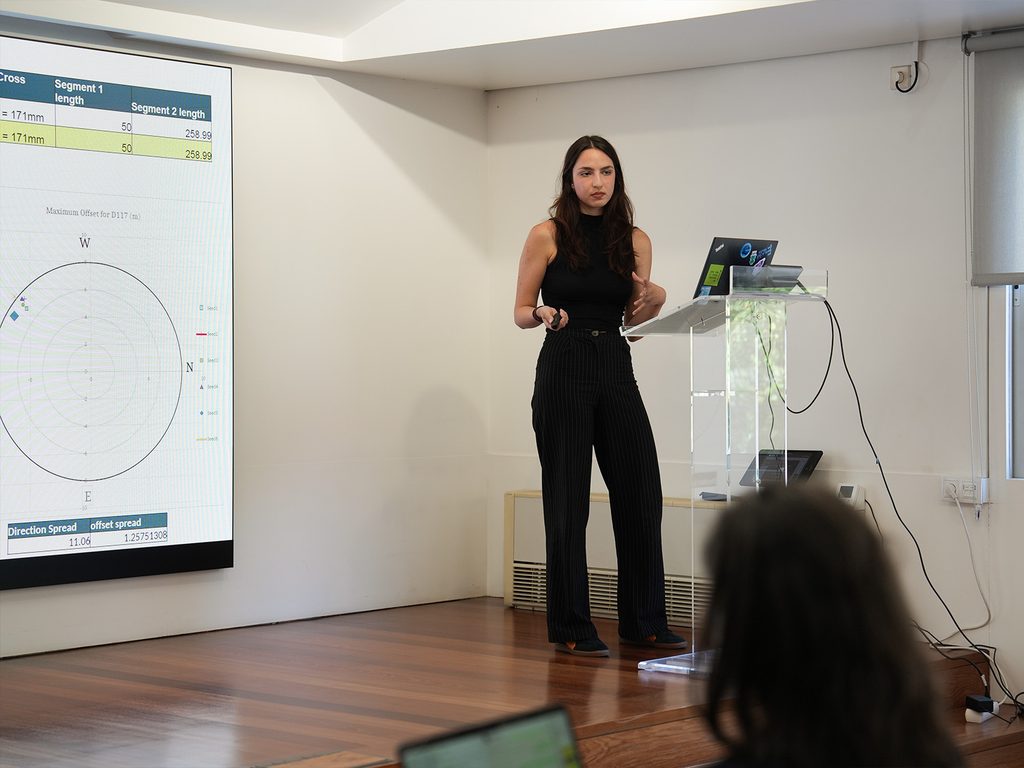
Dorina also highlights how “incredibly lucky” she felt to have Dallán and Diogo as supervisors: “Both are highly competent and knowledgeable researchers and engineers, as well as incredibly supportive and genuinely wonderful people to work with.”
The student particularly appreciated “the balance maintained between guidance when needed and the autonomy encouraged when making decisions and addressing problems.” “Working with them was one of the most important aspects of this internship, and I would be very happy to have the opportunity to work with them again in the future.”
Vasco Carvalho also highlights his mentors’ “great hospitality” at INESC TEC: “I learned intensively and always felt very supported throughout the training process.” During his contact with INESC TEC’s Robotics and Autonomous Systems Laboratory – one of the Institute’s research infrastructures – the student says he became “very interested in the diversity of projects and prototypes that are developed there every day.”
And, as the saying goes, third time’s the charm: Constança Carapuço also praised researchers Diogo Neves and Dallán Friel. The student says they “were always available to help, closely following her work and being extremely patient.” “Their support and encouragement were fundamental in helping me overcome my difficulties throughout the internship,” she says.
And what about the INESC TEC mentors? “The experience was extremely rewarding and enriching,” says Diogo Neves. “Constança’s curiosity, Dorina’s ability to automate and adapt, and Vasco’s analytical rigour” were “motivating” for the researcher, who believes that close, focused supervision, combined with room for individual exploration, can “unlock students’ enormous potential for technical autonomy and creativity.”
Contact with young students, such as through INESC TEC’s Summer Internship programme, “is of fundamental strategic importance,” concludes Diogo Neves. According to the researcher, the initiative makes it possible to “identify and attract new talent in highly competitive and specialised areas of ocean engineering.”
“On the other hand, interns bring renewed energy and new perspectives, carrying out work that genuinely expands the team’s existing capabilities.” According to Diogo Neves, it is a symbiotic relationship: “Students gain exposure to real-world applied research challenges, while INESC TEC strengthens its R&D lines for future projects.”
Dallán Friel echoes his colleague’s words, describing it as a “very positive experience”: “It was rewarding to see the students develop confidence and technical skills over the course of the month while working on challenging engineering problems.”
For the researcher, INESC TEC’s Summer Internships give students “exposure to real-world research and engineering challenges that they might not encounter during their degree”. Dallán Friel highlights the benefits of a “stronger connection between Academia and industry,” particularly through an opportunity for INESCTEC.OCEAN to “inspire and help create the next generation of ocean researchers and engineers.”
This news article was automatically translated using an AI-powered platform.